Less Is More, and Science Agrees: Why Stripped-Down Games Feel So Good to Play

Photo by Photo by Steve A Johnson on Unsplash on Unsplash
You've probably had the experience. You fire up some massive open-world RPG, and within twenty minutes you're drowning — quest markers stacking up, skill trees branching into oblivion, a HUD so cluttered it looks like someone sneezed spreadsheets onto your screen. Then, almost by accident, you download some tiny indie game that costs four dollars and runs on hardware from 2009. Two hours later, you haven't moved from your chair and you feel great.
That's not a coincidence. And it's not nostalgia, either — though nostalgia definitely plays a role. There's actual cognitive science behind why small, stripped-back games hit different, and the indie developers who make them are tapping into something real, often without a psychology textbook in sight.
Your Brain on Bloat
Cognitive load theory has been around since the late 1980s, when educational psychologist John Sweller started studying how much information the human brain could process before performance started to tank. The short version: working memory is limited, and when you fill it up with too much at once, decision-making suffers. Stress goes up. Enjoyment goes down.
Video games have always pushed against this limit, but modern AAA titles have essentially declared war on it. Dozens of active quests. Loot systems with hundreds of variables. Tutorials that last three hours and still don't explain half the mechanics. The result isn't depth — it's exhaustion.
Minimalist games work in the opposite direction. When a game gives you a single mechanic to master, a small handful of visual cues, and a clear objective, your brain doesn't have to fight for resources. It can actually play. The cognitive overhead drops, and what fills that space instead is focus, flow, and — here's the part developers love to hear — genuine emotional engagement.
The Accidental Psychologists of Indie Dev
Most indie developers aren't sitting around reading peer-reviewed journals. They're working alone or in tiny teams, often with severe technical constraints, trying to make something that feels good before a deadline that was already three months ago. But those constraints? They're doing the psychological heavy lifting.
When you can only afford — in time, in memory, in processing power — to include the essentials, you're forced to ask a question that most big studios never have to confront: what actually matters here? Strip away the minimap, the XP counter, the ambient weather system, the crafting menu, and what's left? The core loop. The feeling. The reason someone would want to play this thing at all.
Games like Thomas Was Alone, Downwell, or Mini Metro aren't minimalist because their creators thought minimalism was cool (okay, maybe a little). They're minimalist because every element that didn't serve the experience got cut. What remained was something lean and purposeful — and lean and purposeful, it turns out, is exactly what a brain looking for relief wants.
Color, Space, and the Calm They Create
Visual design plays a bigger role than most players consciously register. Research in environmental psychology — the study of how spaces affect mood and behavior — has documented pretty consistently that visual simplicity reduces stress markers. Fewer competing stimuli means lower cortisol. Cleaner sightlines mean easier spatial processing.
Translate that to game design and you get something like the deliberate palette choices in Celeste or the stark black-and-white world of Limbo. These aren't just aesthetic decisions. They're functional ones. A limited color palette tells your visual cortex exactly where to look. High contrast between player and environment removes the guesswork. Your eyes aren't hunting — they're seeing.
There's also something to be said for negative space. Games that leave room in the frame, that don't plaster every pixel with information, give players a kind of visual breathing room that mirrors what happens mentally. The game feels calm because it looks calm, and that signal travels fast.
Flow States and the One-More-Run Effect
Psychologist Mihaly Csikszentmihalyi's concept of flow — that state of effortless, absorbing focus where time disappears and performance peaks — has been discussed in game design circles for decades. But it's worth revisiting in the context of minimalist games, because they seem to produce flow states with unusual consistency.
Flow requires a specific balance: challenge that meets but doesn't exceed your current skill level, clear goals, and immediate feedback. Minimalist games nail all three almost structurally. The rules are simple enough to internalize quickly, the feedback loop is tight (you either made it or you didn't, usually within seconds), and the goals are legible without a tutorial.
This is why games like Flappy Bird — which is, let's be honest, not a masterpiece of artistic vision — became genuinely compulsive. One input. One obstacle type. Instant feedback. The simplicity wasn't a flaw. It was the entire mechanism of engagement.
Why Players Say They Feel Less Anxious
This is where it gets genuinely interesting. Players who describe themselves as anxious gamers — people who feel overwhelmed by complex systems, who quit games because they can't keep up — frequently report that minimalist indie games are the titles they actually finish. More than that, they describe the experience as restorative.
That word keeps coming up. Restorative. Not just fun, not just relaxing — actively replenishing. There's a reason cozy gaming has exploded as a category, and it's not entirely about cute aesthetics. It's about games that don't demand more from you than you have to give. Minimalist design, whether or not it's explicitly "cozy," tends to share that quality. It meets you where you are.
For a lot of players — especially adults with jobs, families, and the general low-grade stress of American life in the 2020s — a game that doesn't require a 40-hour time investment to understand isn't a lesser experience. It's the right-sized experience.
The Tiny Window That Opens Up Everything
There's a metaphor baked into what this site is all about, and it fits here almost too perfectly. A tiny window doesn't show you less — it focuses your attention. You're not scanning a panorama; you're really looking at something. Minimalist games work the same way. By narrowing the frame, they intensify what's inside it.
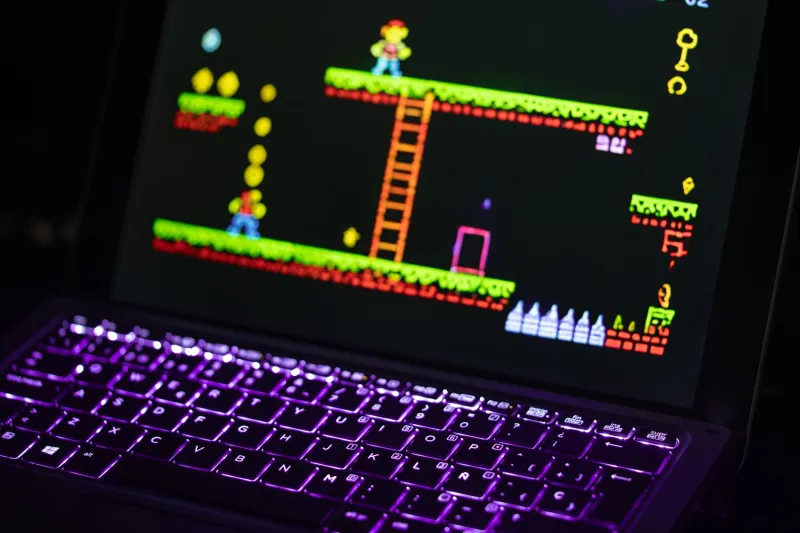
That four-color platformer isn't impoverished. It's concentrated. Every sound cue carries more weight because there are only three of them. Every color choice communicates something because the designer couldn't afford visual noise. Every mechanic matters because there's nowhere to hide a bad one.
Indie developers stumbled onto this truth not because they were smarter than big studios, but because their constraints demanded honesty. And what they accidentally discovered — what cognitive scientists have been documenting from a different angle — is that the human brain doesn't want more. It wants better. It wants signal without noise, challenge without chaos, and a game world small enough to actually feel at home in.
Turns out, a tiny window is sometimes exactly the right size.