Designed for the Desk Lamp Glow: How Indie Devs Are Quietly Owning the Small-Screen Era
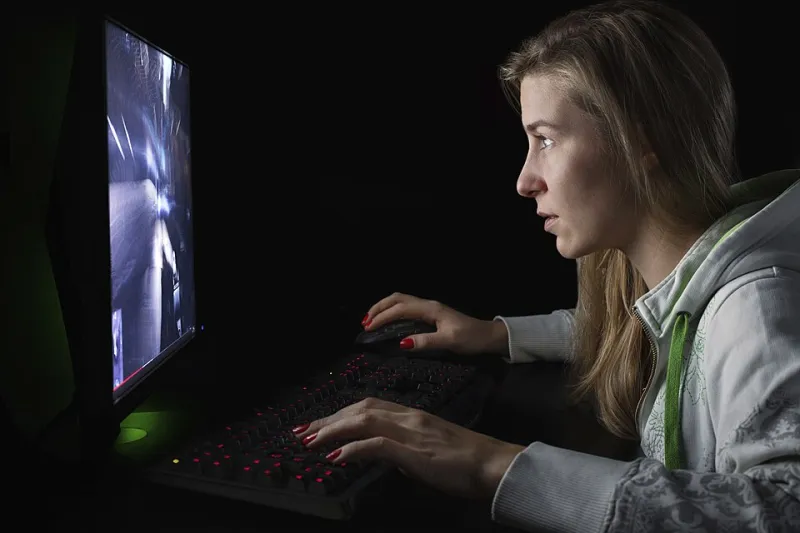
Photo: verkeorg, CC BY-SA 2.0, via Wikimedia Commons
There's a particular kind of gaming moment that doesn't get talked about enough. It's eleven at night, your laptop is balanced on your knees, the room is lit by nothing but the screen, and you're completely, unreservedly absorbed in something that fits perfectly inside that glowing rectangle in front of you. No giant TV required. No surround sound setup. Just you and a game that seems to know exactly how much space it has to work with.
That moment — cozy, intimate, weirdly perfect — is something AAA publishers have spent two decades accidentally designing against. And it's the space where indie developers have been quietly building an empire.
The Screen Nobody Was Designing For
For most of gaming's blockbuster era, the assumption was simple: bigger is better. Bigger worlds, bigger budgets, bigger resolution targets. The industry benchmark shifted from HD to 4K to 8K, and the implicit message to players was that you needed a serious display setup to get the full experience. A 15-inch laptop screen? That was a compromise. A secondary monitor on a cluttered desk? Good enough to get by, but not ideal.
Except millions of people were playing on exactly those screens. Are still playing on them. According to Steam's own hardware surveys, a significant chunk of the platform's active users are running displays smaller than 1920x1080 — the supposed minimum for "real" gaming. Laptop gaming, in particular, has exploded, driven by remote work setups that doubled as gaming rigs and a generation of players who never owned a dedicated gaming room to begin with.
AAA publishers largely looked past this. Indie developers looked directly at it.
Building With the Window in Mind
Ask any indie developer who has shipped a successful small-scale game about their design process and you'll hear some version of the same thing: they start with constraints, not possibilities. The screen size isn't something to work around — it's one of the first decisions that shapes everything else.
Take pixel art as the obvious example. The resurgence of 16-bit and 8-bit visual styles isn't purely nostalgia-driven, though that's part of it. Pixel art reads clearly at small sizes in a way that high-polygon 3D environments simply don't. A character rendered in careful pixel work pops on a 13-inch display. That same screen showing a photorealistic open-world game can feel muddy, overcrowded, and exhausting to parse.
Similarly, games with minimal UI clutter — no sprawling HUD elements, no quest markers competing for attention in every corner — translate naturally to smaller windows. When your canvas is compact, every pixel of screen space is precious. Indie devs have internalized this in ways that major studios, designing primarily for 65-inch living room setups, simply haven't needed to.
There's also the matter of readability. Text legibility, icon sizing, the distance between interactive elements — these details become critical on smaller screens, and indie developers who think carefully about them end up with games that are genuinely more accessible across a wider range of hardware. That's not just a design win. It's a market advantage.
The Laptop Is the Living Room Now
The cultural shift here is worth sitting with for a second. The traditional image of a "serious" gamer involved a dedicated space: a gaming chair, a tower PC, multiple monitors, peripherals everywhere. That image still exists, but it describes a narrower slice of the actual gaming population than it used to.
For a lot of American players — college students, people in smaller apartments, folks who share living spaces and can't commandeer the TV — the laptop screen is the primary gaming environment. It's where they play before bed, during lunch breaks, on weekend mornings with coffee. It's a personal, close-up experience that has more in common with reading a book than watching a movie.
Indie games, almost by accident and then increasingly by intention, fit that experience better than anything else on the market. A game that runs in a windowed mode without complaint, that looks sharp at 1366x768, that doesn't require thirty minutes of loading and patching before you can play — that game respects how people actually live.
Constraints as Creative Fuel
Here's the counterintuitive part: designing for small screens doesn't just make games more accessible. It often makes them more focused, more elegant, and more memorable.
When you can't rely on sheer visual spectacle to carry a moment, you have to think harder about what that moment is actually about. A tiny window forces clarity. Is this mechanic fun? Is this visual communication working? Does this layout make sense? There's nowhere to hide behind scale.
Some of the most beloved indie releases of the past decade — games that players return to years after finishing — share this quality of feeling deliberately considered. Nothing is wasted. Every screen, every menu, every interaction feels like someone thought carefully about how it would look at actual human scale, on an actual human-sized device.
That kind of intentionality is hard to fake, and players feel it even if they can't articulate exactly why a game feels so right to play.
What AAA Can't Buy
The major studios aren't blind to this. Several big publishers have launched smaller-scale indie imprints or acquired beloved indie teams in an attempt to capture some of that energy. The results have been mixed at best. You can't simply allocate a budget line for "cozy and intimate" and expect it to materialize.
The small-screen advantage isn't really about screen size at all, in the end. It's about a philosophy of design that starts from the player's actual situation rather than an idealized setup. It's about making something that works beautifully in the real environments where real people play — the desk with the lamp, the couch with the laptop, the bedroom with the modest monitor.
Indie developers didn't stumble into this by accident. Many of them are those players. They built for the screens they had because those were the screens they understood. And in doing so, they built for a much larger audience than anyone gave them credit for.
The Window Is the Feature
Tiny Windows Games exists because of this exact idea. The small screen isn't a limitation that gaming needs to escape. It's a context that deserves games built specifically for it — games that feel at home there, that breathe naturally in that space, that don't ask you to apologize for not having a home theater setup.
The indie developers who figured this out early are reaping the rewards now. Their games run on basically anything, look great at any size, and feel like they belong in the quiet, personal corners of people's lives where gaming actually happens for most of us.
AAA studios are still fighting over who gets the biggest piece of the 4K television screen. Meanwhile, indie devs claimed the laptop window years ago — and nobody's taking it back.